
Author Q&A with Crystal Sidell
Author Q&A with Crystal Sidell
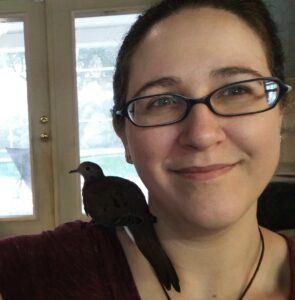
A native Floridian, C. L. Sidell grew up playing with toads in the rain and indulging in horror stories. She holds a master of arts in both English and library & information science, moderates two creative writing groups, and reviews books for the Florida Library Youth Program. When she’s not busy working, she’s usually looking for ways to spoil her house full of pets or stopping traffic to rescue animals. She dreams of traveling the world and hopes to someday revisit New Zealand. Her work has appeared in 34 Orchard, 50 Haikus, Horror Magazine, Quarantine Quanta, The Scribe, and Triangle Writers Magazine. Her debut novel Repetition was published in June of 2020.
1. Where is your favourite place to write?
I do most of my writing in what I would call the den area. The room is perfect for writing—it has a wall with built-in shelves and space for me to house my laptop. One of the reasons I enjoy writing here (aside from the fact that I can look up at any time and see books!) is that there’s lots of natural light—there are windows and a set of double-doors leading out to the back porch. But I also spend a lot of time here because this is an open area of the house where my birds can see me and the dogs and cats can be near me if they want to be.
2. How do you approach starting a new book?
I write more short stories and poems than I do novels, so my process for writing longer works is still evolving. My first novel, Repetition, was originally going to be a short story. After I started writing, however, I realized that the events leading up to the pivotal scene were expanding and multiplying. The original draft (it went through two major revisions over the years) definitely falls into the “pantsing” category. But I was writing every day, so the characters and scenes were always fresh in my mind.
I decided to write my second novel (not yet published) in January of 2019. For this one, I invested much more forethought. I decided in advance how many words the book should have as well as the projected number of chapters. Then I started working out the protagonist’s character as well as the supporting cast. This included physical traits, characters traits, hobbies, etc. After I had the characters figured out, I started plotting potential events for each chapter. (This is a middle grade fantasy work, so I felt pressured to keep the book fast-paced from the start.) Once I began writing, I did find that some that some scenes unfolded quite differently from what I’d first imagined while others got replaced with different events altogether. I’m glad I took the time to pre-plot though because this helped me keep the story on track and the book ended the way I’d originally intended.
I’m currently in the baby stages of writing a third novel—another adult mystery/horror—and I’m pretty much sticking with this system. So far, it’s working!
3. Have you always wanted to write?
Without question! I remember creating my first “book” in the first grade. I believe it was about bears and ice cream? My teacher laminated it and had it spiral bound. And I’m pretty certain my mom still has it stored in a plastic bin somewhere…
I continued to think of myself as a “writer” as I grew older. I even had dreams of becoming the next Stephen King. (A common fantasy among horror writers, I’m sure.) But oddly enough, I wrote very little in the way of prose. As a teenager I did write lots of poetry, but it was mostly as a form of emotional release—I didn’t study the craft or put too much thought into what I was putting to paper.
I spent much more time immersing myself in books—usually suspense or horror. It wasn’t until I entered my third year of college that I began to seriously tackle writing. And I haven’t stopped weaving stories since.
4. How do you handle criticism?
I’m hoping you mean constructive criticism?
As a writer, I think one of the worst mistakes we can make is to think that something we have written is as good as it can be. Because this is rarely the case.
I’ve belonged to a writing group for five years now, and I can honestly say it’s the best decision I’ve ever made. I treasure constructive critical feedback from other writers. A thoughtful writing group will let you know when you might need to expand on a scene, clarify action, change your dialogue, reorder sections, rework clunky writing, provide more descriptions, etc. Regardless of whether or not you agree with a particular comment/suggestion, you’re able to “see” your work from another person’s perspective. I consider this invaluable during the writing process.
But if someone’s response isn’t constructive? It’s just critical?
When this happens, I try to remind myself that no story will please every reader. Sometimes a reader will react negatively to what you’ve written simply because your story isn’t a genre they enjoy. That’s on the reader, not the writer.
So I do think it’s important to identify where the criticism is coming from and if it’s relevant to the craft.
5. Tell me about your current work. Tell me about your main character.
My current work is a middle grade fantasy adventure (sprinkled with humor!) that explores the power of creativity and also carries a positive underlying message about what being a family really means. The protagonist—eleven-year-old Azalee—finds a magic whistle that transports her to Wonderland. What starts off as a brief excursion soon turns into an adventure when the Queen of Spades steals the whistle and offers Azalee an ultimatum: Find and return the queen’s missing Jabberwock or remain stuck in Wonderland forever.
Azalee is such an endearing character! She treasures her friends, enjoys solving puzzles, and she’s excited at the prospect of becoming a big sister. Though she doubts her creative abilities, she’s still willing to work hard to produce quality work when the occasion calls for it. She’s fearless—who else would go after a Jabberwork? And she has a good heart; she will protect those around her, even if it means that she’ll have to sacrifice her own happiness.
At this stage, I believe the novel only needs some minor tweaking. I’m hoping to find a home for it soon, as I believe children will enjoy Azalee’s stubborn and selfless spirit, the quirky characters she interacts with, and the various situations she encounters during her time in Wonderland.
6. Would you want your book made into a film?
As an avid fan of horror films, my initial inclination is to shout: “YES!”
I would be incredibly honored to see Repetition adapted to the big screen. But, in the wrong hands, the story could easily fall into cheesy territory which would – frankly speaking – make me cringe. In my opinion, a lot of horror films today focus so strongly on gore and scare factors that the scripts themselves don’t receive the attention they deserve.
Though I often refer to Repetition as horror, I’m really shortchanging it by giving it that label. You might call it a mystery, a thriller, even women’s fiction—with a little bit of chills and blood tossed in the mix. A major component of the story focuses on how Marche copes with her recent trauma. She’s lost her husband—her best friend—and is trying to figure out how to survive without him. And a big part of this involves learning how to become a strong single parent to her five-year-old daughter. She also has a strained relationship with her younger sister that she’s eventually going to have to address.
So yes—I would love to see Repetition made into a film… as long as the director would be willing to take the time to explore the psychological complexities of Marche’s character. Marche really is the heart of the story—the ghosts are just there to give you shivers.
*Affiliate Link*

You May Also Like

Author Q&A with Jamie Jackson
Author Q&A with Regina Brownell
