
Author Q&A with Karen Heenan
Author Q&A with Karen Heenan
*This post contains affiliate links*
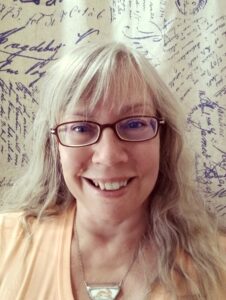
Karen Heenan was born and raised in Philadelphia. She fell in love with books and stories before she could read, and has wanted to write for nearly as long. After far too many years in a cubicle, she set herself free to follow her dreams – which include gardening, sewing, traveling and, of course, lots of writing.
She lives in Lansdowne, PA, not far from Philadelphia, with two cats and a very patient husband, and is currently hard at work on her next book.
1. Tell us about your writing/published book(s)
I write historical fiction, mostly set during the Tudor period. It’s an era I fell into as a child and still haven’t climbed out of. My first novel, Songbird, was published in November, 2019, and stemmed from a throwaway fact I read in a biography of Henry VIII, that he was such a passionate music lover he actually bought children to sing in the royal choir. The idea wouldn’t let go of me, and it turned into my first book.
A Wider World, coming out in April, 2021, follows Robin Lewis, a secondary character from Songbird, as he grows up in a similar situation, but being male, escapes into education and a life both in and outside the court. His story spans almost 50 years, and was a lot of fun to write. I fell into a lot of research rabbit holes.
I’m currently working on a sequel to that, titled Lady, in Waiting, and also a novel set during the 1930s, which I intend to self-publish. My three Tudor books are published through Authors 4 Authors Publishing Cooperative.
2. How do you approach starting a new book?
It generally approaches me, and if I’m lucky, I know what it’s trying to say, and take notes. I couldn’t avoid Songbird, and wrote it over a period of years, but when I finished, I thought I was equally done with the Tudor era. Then I heard a voice say, “They said I would not end well,” and I listened, and it turned out to be Robin, and that is the first line of his story.
Because I’m familiar with the period, I have at least the broad strokes of history to build on, but there’s always a dark and dusty corner that needs to be poked into to bring the story to life. I try to write my first drafts based on what I actually know, and leave myself notes in the text about what I need to research to flesh it out in the second draft.
3. Have you always wanted to write?
Absolutely always. I’ve loved books since before I could read, and it occurred to me, at a very early age, that someone had to write them all. And unlike my other childhood ambitions – prima ballerina, great artist – all I needed to be a writer was pen, paper, and practice. I’m still practicing, but I’ve at least upgraded the technical aspect: I either write on my computer or dictate into my phone while out walking, and then download it to my computer when I get home and tidy it up.
4. Do you do research for your books? If so, what kind of research?
My love of research is probably one of the reasons I got into writing historical fiction. I’ve tried writing contemporary, but I keep going off on strange tangents to have something to research, and it doesn’t help my story, so back to the past I go.
I start with basic historical knowledge – the times in which my characters will be living, the political/religious/royal history, and any major events that would occur during the time period of my novel. Since I write “real historical character adjacent” – my characters interact with real people, but I don’t write from the POV of any real person – I need to know what was going on when and where.
I have a decent library of general English history, which suits for my current purposes, but I’m also acquiring a similar collection for the period 1920-WWII, for future books. Once I have the era down, I start drafting, leaving blanks where I need to fill in, and before the second draft, I make a list of all those missing bits and go hunting specifically to fill them in. Specific dates that things happened, locations if at all relevant. There’s an amazing amount of documentation online about the Tudor period, for which I am extremely grateful.
Although I will always love my books, I do generally start my searches online. I won’t take a Wikipedia article as gospel, but it’s a good starting point, and the list of references at the end have sent me in interesting directions. For reference books, unless it’s something with a lot of pictures, I will buy or borrow ebooks, because I can highlight and download my notes onto my computer and put them in my research folders for whatever project I’m working on.
5. How do you fit writing into your everyday life?
I fit it in because it’s important to me, and because if I don’t write, I’m very annoying to be around. But it fits because I don’t make any hard and fast rules about when I write, or where, or if I need to have a candle lit or a cup of tea on my desk. All those are nice things, but if I can’t get to my desk at that perfect time, I don’t want to feel like I’ve blown the day. I write in snatches, when I can, and I’ve taught myself to dictate rough drafts on my phone so that I can get out of the house on nice days and combine writing with exercise.
I also consider reading/researching, plotting, making notes, etc., as part of writing, so even if I don’t actually get any words down, so long as I’ve accomplished something writing-related, I feel good about it.
6. Tell me about your main character(s)
I’m going to be greedy here, and tell you about all my main characters, because they all have something in common.
Bess Llewellyn, the main character from Songbird, is a poor but very talented child sold to the king by her father. (It was for her benefit, but still a difficult thing for a child to take in). She assembles a “found family” at court, but has difficulty figuring out where she fits into her life, and who to love and trust.
Robin Lewis, in A Wider World, was Bess’s childhood antagonist and friend. They grew up in similar circumstances, but where Bess struggles to find her place, Robin decides to make his own. When he grows out of his place at court, he goes to Oxford, travels the world, and returns to court to work under Thomas Cromwell, just in time for the dissolution of the monasteries. Part of his childhood was spent in a monastery, and he now has to face whether or not he can destroy his own past.
Margaery Preston, of Lady, in Waiting, arrived as a minor character at the end of A Wider World. She makes an impetuous decision to marry, to get out of a family arrangement, and to bring her grandmother back from exile to England. She thinks she’s going into a quiet life in Yorkshire, but her new husband is appointed to the court of the young Queen Elizabeth, and in addition to having to learn how to be married (and get acquainted with her husband), she has to do it in an environment that is totally alien to her.
—–
Where can you find Karen Heenan?


You May Also Like

Author Q&A with Richard James
Author Q&A with Paul Saylor