
Author Q&A with Rick Bailey
Author Q&A with Rick Bailey
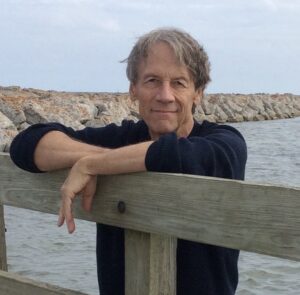
1. Tell us about your writing/ published book(s).
I’ve written two collections of short essays, American English, Italian Chocolate: Small Subjects of Great Importance(2017) and The Enjoy Agenda, at Home and Abroad (2019). A third collection, Get Thee to a Bakery, will be published Spring 2021. All three are published by University of Nebraska Press.
You might call these books memoir in essays, but that would be something of a misnomer. They are not really the story of my life so much as stories from my life, part of a memory project I’ve undertaken. Think of all the life that goes flying past you on a daily basis, a lot of it funny, some of it painful, much of it slightly absurd. Lots of this stuff I want to remember. Like many people today, I want to write my life. Some capture these moments in diaries and journals. My essays are memory captures that dig down, exploring how these small details of everyday life resonate, how they trigger memories of other moments and events, how they relate to current events and literature, science, and history.
Here’s a list of some of the topics I address in my essays: food, wine, family, friends, bugs, cows, lakes, rivers, canyons, fish, floods, phones, photos, books, music, pasta, hamburgers, teeth, feet, graveyards, eggs, yoga, baseball, breakfast, lunch, wontons, monkeys, flipflops, haircuts, flies, beans, Beatles, smiles, corn, Ibsen, Shakespeare, poo, trees, coffee, eyeball, groans, outhouse, endtimes, nutmeg, winespeak, meatloaf, beards, dance, treadmills, cheeses, Bacco, Mao, nightmares, daydreams, ice, cream, and frogs.
2. How do you approach starting a new book?
I taught writing online for 20 years and developed the habit of writing every morning for and with my students. The writing I did in the courses I taught evolved into a blog I write. Through the day, my “notice apparatus” is always humming in the background, triggering memory and awakening curiosity. I make mental and actual notes. Every morning I sit down and write up these explorations. When these forays take shape and begin to read and feel like an essay, they migrate to my blog. Doing this on a regular basis, like for a couple years, gives me a lot of material that I can shape into a manuscript for a book.
3. Do you like reading the same books you write?
No, not particularly. I don’t read that much memoir. I like contemporary fiction, especially works with a good feel for the human voice and with artful dialogue in particular. In daily life I like to listen to how people talk. I look for that in my reading, too.
4. How do you choose your book’s title(s)?
Titles come from essays in each collection. American English, Italian Chocolate is the title essay of the collection. Same as The Enjoy Agenda. I love thinking about the titles of my essays. When I was avid about sending out short pieces for publication in magazines, I followed the advice of an editor of a fine literary magazine. He said each piece he picked up, he looked at the title and the first two sentences. You had to grab him fast. So I try to be interesting when I think of a title: “The Birds and the Beatles.” “iSmell.” “Buddy, Can You Spare a Mao?” “Cowboys and Vespers.” “Teeth First.” “Me and Velociraptor and Forrest Gump.” A good title gives your work at least a fighting chance to be read.
5. Do you do research for your books? If so, what kind of research?
Part of my work as a writing teacher focused on information literacy, searching for the good stuff (story, example, data, informed opinion) that enhances a writer’s content. Part of my writing process involves looking for articles in reputable publications, newspapers, magazines, and journals. When I wrote an essay about having a toothache in Venice, I learned that dental science gets a big start from a Venetian, Bartolomeo Eustachi, whose Libellus de dentibus, published in 1563, is described by the Journal of the History of Dentistry as “the first book devoted to the structure and function of teeth.” I also stumbled on a number of home remedies for dealing with toothache. (I went the antibiotic route.)
Because I’m writing essays, research usually plays an important role in my work. In Get Thee to a Bakery, for example, there’s an essay called “Monsters.” It’s about environmental degradation and its impact on insect populations. My wife woke me up in the middle of the night and said she couldn’t sleep. She was reading about the great bug die-off. That got me thinking about how buggy my life was when I was a kid. I remembered smears of dead bugs, for example, on the windshield of our family car in the summer. These days, on the windshield, hardly any bugs. Where are they? Over the next few days I did some research, leading me to evidence of “climate-driven declines in arthropod abundance causing restructure [in] a rainforest food web,” according to Proceedings of the National Academy of Sciences. Research usually helps me enlarge upon my subject.
6. How do you fit writing into your everyday life?
I write early in the morning, usually starting around 4:00 a.m. I aim for a minimum of 250 words a day. Often I wake up thinking about the writing I’m going to do. In a way, I’m already writing before I actually start writing. The rest of the day, that thinking continues. I have my 250 words, but I’m still thinking and noticing and wondering. On walks, or in the car, or while I’m washing dishes, an idea or detail will present itself. I write in Google Docs. I can open the file for whatever I’m writing on my phone and voice-to-text a note to self, then go back to it later on my computer. I don’t trust myself to remember these little details. If the opportunity presents and if my thinking is productive, I usually sit down and write another 250 words that day. Yesterday, a couple such notes: “Look for the interview with Katie Mack, her book The End of Everything. What is ‘heat death’?” “A trailer by the side of the road. Flagpoles for sale.” “Pinnebog Road. Who is Pinnebog? Or is it just a bog?” “The closer to the lake we get, the more Trump signs we see.” “Pears, a short-lived pleasure.”
Yes, there are dry spells–a few days, a week or two–when I’m not writing much or not at all. Even though I trust the process, that still makes me nervous. Am I done? Have I run out of things to say? And everyday life can get crazy. You have no time or energy or no peace and quiet.
Fortunately 4:00 a.m. comes every day, and I can get back to work. In Writing the Australian Crawl, William Stafford says of his process, “I do not have commitments, just opportunities, a dizzying struggle with the Nowness of experience.” I love that term, the Nowness. I usually compose in present tense. I proceed with the belief that tomorrow something will happen or occur to me that connects with what I’m writing today. In the essay on the bug die-off, I went to Puerto Rico. Writing the essay on toothache I learned that in the Renaissance, smiling was thought to be bad manners. In portraits, only peasants smile. (See Franz Hall.)
When I finish an essay, I want to see something in there that I didn’t know I was going to write. This pleasure in discovery is one of things that keeps me going.
*Affiliate Link*


2 Comments
Colleen
Thanks Rick. The 4:00 am really resonates with me, partially because this is such a huge commitment, which any worthy endeavor requires. I’ve been so busy lately but look forward to reading your work and new book. Take care.
Colleen
Elizabeth Holland Author
Thank you for reading the interview 🙂