
Author Q&A with William Schlichter
Author Q&A with William Schlichter
*This post contains affiliate links*
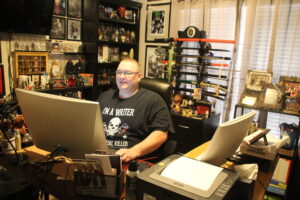
1. Where’s your favourite place to write?
I can write anywhere. I have a laptop for travel and tons of napkins with notes scrawled on them. But I love to write at my desk. I have a retro keyboard that looks and sounds like the old-fashioned typewriters. My office is a place of inspiration for me down to my taxidermied death’s-head hawkmoth, swords and collectibles of all my adventures. Most of the items on display have their own story.
2. How do you approach starting a new book?
I do and don’t have the same method. When I have an idea, I will write on it for a few pages, and then if I think it will make a good story, I write the ending. If I can’t write an ending, then it ends up in a folder. You never know when it might strike a chord. I envision an ending where I work on my main characters and write backstory and make them people. Discuss their motivations, fears, education and, most important, give them a secret. Many times, the secret remains with me, but in my detective story it is revealed and maybe they can heal. I will hint at it, but unless it’s germane to the plot, I keep it. But it will change how you write your character and how the character behaves when the secret comes up in the text. I work up a rough outline, and I mean rough. And no matter how much I say, I am going to map out the book I don’t normally get much past fifty percent. The story takes over and I spend time getting on the page instead of planning. I have even attempted a different outlining method with each new book and I end up abandoning it. I do, however, have plenty of napkins with ideas I don’t want to forget to add in stacked on my desk. I always get great ideas when I am doing anything but writing. Just pull the car over before you write them down.
3. Have you always wanted to write?
I tell this story at many comic convention panels and book signings. But I remember telling my first-grade teacher I was going to write a book. Before that, I saw Star Wars at the drive-in and knew that’s what I wanted. Not become a Jedi or a smuggler, but the creator of fantastic worlds. I wrote but never in a disciplined manner. In high school, I focused more on the sci-fi story in my head and completed The Dark Side, a version unlike the published one. I sent it off and, along with scores of rejection letters, a few publishers said, “You are close.” I knew they rarely gave real responses so those meant a lot. I kept writing. I’d rework my sci-fi novel and send it off to publishers. Then, I wrote the next novel and several more. Two have been published so far. The others need work. The most important aspect of my experiences is the twenty-year gap between high school and being published. You can’t give up, and you have to keep working on a project until it’s ready. I would rewrite it again if I could. With each new book I write I get better at writing.
4. How do you choose your book’s title(s)?
I don’t think anyone has ever asked this. I tell my students to title papers last. Some will spend too much time attempting to come up with a title. I follow my own advice, but normally I have a decided title somewhere in the middle of writing a novel. The zombie novels, despite the serious nature of the stories, have campy titles. I wanted the first book to follow a man with no name type character, so I went with the classic The Good, the Bad, and the Undead. I stuck with campy for Book Two where the characters travel four-hundred miles to Memphis where a possible cure is rumored. Book Three, Aftershocks, has a double meaning dealing with fallout from all of the storylines converging. And when Book Four hits the shelves, I stick with being campy, but also it hints at a further danger: Winter is Coming.
My science fiction adventure titles fit around what the crew faces. SKA: Serial Killers Anonymous is easy— a group of addicts attempting in secret to curb their murderous impulses.
My upcoming detective mystery has the name of a popular speakeasy frequented by many characters. I thought The Dark Elf was catchy. I really think the title, even if it’s an afterthought, should tell something about the book. The novel I am currently writing has a working title of The Forgotten Murder. I don’t know if that will be the final title, but the death it references carries through the book, so it’s appropriate. As I write, if a better title pops into my brain, I will consider it. I don’t plan a title I like to think it fits the story.
5. Do you do research for your books? If so, what kind of research?
My next novel to be released, Sirgrus Blackmane, demonstrates the most level of research I’ve put into a project.
I do not believe enough attention is placed on those suffering from shell shock, also known as PTSD. I have been exploring this topic through my 1923 detective who suffers in silence a few short years after The Great War. During this time, shell shock was never openly discussed, and soldiers were expected to man up and just move on. Though PTSD is an underlying theme of the novel, it is my hope that through the constant drinking and nightmares my character experiences, an awareness of the condition we as a society have only begun to address in our soldiers a hundred years later, is brought about.
I am constructing a fantasy/alternate history novel where dragons and dwarves still exist in a modern world. The piece also explores the speakeasy culture of the 1920s. I match my writing for this novel with that of the Sam Spade detective novels, down to inserting the language of the time period and style. In those novels, the character’s liquor choice speaks to their personality as well as the description of the clothing attire. Character description was more about the clothing choices than the physical build of the character. It was a time when men were men and women had strength and faced a growth in the sexual revolution, but were still women. Alcohol played a major role, and the type of drink selected said much about a person’s character.
I feel encapsulated in all these elements through research. Other projects I study, read and watch documentaries. Interviews are important. I will ask nurses and police officers I know how they handle certain situations. I have plenty of former students who will tell me about their military experiences. I have not spoken to any famous murderers, but my first teaching job was in corrections. It gives a flavor of reality no matter the nature of the story. I actually went and fired a Thompson Submachine gun and worked that experience into the novel.
I like to think I have done my research and add in details that make the scene feel real but not at the compromise of the story. You don’t have to know guns to write one believability. Don’t put a silencer on a revolver. Read enough to know that. But don’t go into so much facial detail you bore the reader.
6. Describe your perfect character to me
I study films and television as part of my degree, and I study books because you should be reading as much as you are writing. Character is the driving force behind any story. We watch and read the same story over and over again. But what draws us is in a character. I love Rick in Casablanca and how we learn so much about him through all the other characters. Ethan Edwards in The Searchers. He is a haunted man long before his family is murdered. Indiana Jones, Malcom Reynolds and Captain Kirk are some of my favorites. But the best characters are those that have flaws and must overcome those flaws. Hamlet comes to mind, but the two characters I think are Worf from Star Trek and Carol from The Walking Dead. Worf grows from a background character to a fan favorite. But he develops through two television series. Then expand his story. Whereas Carol from The Walking Dead goes from being an abused housewife to a leader of the survivors. I don’t think any other characters have changed and become more than they are on any other show.
7. Tell me about your current work
Due to the popularity of my first serial killer novel, my publisher asked me to write another one. I wanted to explore some new characters and not just repeat what I did in SKA. This novel, we follow FBI Special Agent Andrew Sullivan and he tracks down three different serial killers. I spend time with each of the killers and their motivations. I don’t want to just write a cop-chases-the-bad-guy tale. Every male our first killer ever dated has ended up dead. Our second killer forces Sullivan to return to his hometown and seal some his own childhood issues. The third killer operates a bed and breakfast, and all I’ll give away is if you choose to stay there, don’t eat the breakfast sausage. I want to explore the deep places of the human mind. I do a lot of research and so many real-life serial killers were so normal that no one had any idea until they got caught. And many of those real-life people wanted to get caught. They craved fame. It is a fascinating subject, and more people are interested in seral killers that I ever realized.

You May Also Like
Author Q&A with Regina Brownell

Author Q&A with H.G Ahed