
Author Q&A with Elizabeth M. Hurst
Author Q&A with Elizabeth M. Hurst

Elizabeth was born and bred in the picturesque harbour town of Whitehaven in the northwest of England, where the long, wet winters moulded her into a voracious reader of fiction to escape the dismal weather.
Having started writing around the age of 40, she later set about creating a freelance editing and proofreading business, EMH Editorial Services. In 2018, she quit the corporate world and concentrated her energy towards her love of the written word.
Elizabeth now lives with her partner in the warm and sunny south of France.
1. Have you always wanted to write?
I was a late arrival to the writing party. I’ve always been a voracious reader, and at school was reading books for children way above my actual age, but I never thought I could write anything myself at all. I just didn’t think I would ever be good enough.
It was a random suggestion by someone that I should give it a go and see what happened that set me off. I had not long turned forty years old back then and I figured that, as mid-life crises go, it would be pretty safe. I’m still working it out.
There are many writers I know who didn’t turn to the craft until much later in life, even after retirement. It’s one of the few pastimes that has no age barrier, which is wonderful!
2. Tell me about your current work
My latest novel, A Light Shines in Darkness, is a departure from my novella series, and it has been an enormously rewarding challenge. It’s the story of a pious noblewoman in 14th century Italy, Angelina Angioballi, who was determined to remain chaste and serve God through works of charity. In particular, she wanted to help women and girls receive an education and allow them a choice of joining her community rather than be shackled in a loveless marriage.
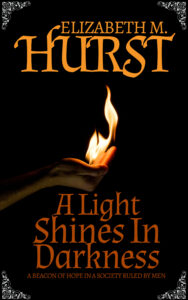
I was inspired by a visit to her family’s estate and her birthplace in the village of Montegabbione, near Perugia, Umbria, in 2017. The resident marquis mentioned her in passing during a wine tour of the castle and I was fascinated.
It was a dark period in the history of the region. The Back Death had swept through Europe only 20-30 years before and was still claiming victims; Angelina herself had lost several family members. There was a lot of pressure on society to recover their local economies to alleviate poverty, and this meant women were expected to bear many children to, in time, supply their towns and villages with workers. Angelina’s mission was met with scepticism by the patriarchal society of the day. In my story, this is personified by the feudal lord, Biordo Michelotti, a ruthless mercenary who wants to marry Angeina to improve his social status and line his pockets with her inheritance. The consequences are devastating.
3. Tell us about a scene that you loved but had to edit out of your book
I wasn’t far into the first draft of the novel when I had a blast of inspiration during a writing retreat, and a fabulous scene of a monk performing self-flagellation popped into my head. It was absolutely the kind of thing many religious followers did back then, especially members of the clergy, and I had the character in my mind so I wrote the scene.
It is raw and visceral, full of emotions: pain, regret and sorrow mostly, and there is a story between the lines that is hinted at but not explored. I really wanted to add it into the novel somehow, and I experimented with moving it around into different chapters, but the problem was that it just didn’t fit. There was too much character development for someone who only appeared a handful of times, and it bore little relation to my actual story. As I moved onto later drafts, the character in question morphed into someone else with a different name, and this character vanished entirely from the narrative. So I decided to cut the whole scene. It has a new lease of life on my blog, and you can read it here.
It was a wonderful learning experience, and I realised then how difficult it is to ‘kill your darlings’!
4. Do you do research for your books? If so, what kind of research?
For historical fiction, research is essential. The tricky part is finding reliable sources (top tip: DON’T use the internet!) and knowing when to stop and start writing the book.
I prefer to try and be as accurate as possible when I’m writing about another time period, so I want to know exactly how my characters would have lived: what they ate, how they dressed, what their social status was, what they did for a living.
It’s also useful to have some idea of any important historical events that occurred during the timeline of your book, so you can weave them into your story for authenticity. Some things, like a war, for instance, would have had an impact on your characters’ lives, so it’s important not to overlook that. For characters among the nobility, the death of a monarch could have far-reaching consequences on their status, so they would have been keen to jostle for favour at court with the incumbent king or queen. In Europe, the boundaries between countries have been changing for centuries, and some countries have been united as we know them today for a relatively short period of time. Italy, for example, has only been a united nation since the late 19th century.
All of this information forms an essential backdrop to a novel set during a turbulent historical period.
In terms of sources, look for text books for your chosen period written by historians, archaeologists or other academics with qualification in their specialist fields. These people are concerned only with the facts, not with forming a story. The extent to which you choose to stick to those facts is up to you, but always to know what they are before you start.
Finally, what’s the best piece of advice someone has given you about writing, marketing, or just generally about life?
One of my favourite things about the writing community is the extent to which peole help wach other out all the time for no reward, whether it’s reading and reviewing each other’s work, or simply a helpful tip given while chatting over a cup of tea at a conference.
Also, there is, frankly, a bewildering array of books to choose from that will throw all sorts of advice at you. (Assuing you actually read them, that is — I have bookshelves full of these that I’ve never read!)
The best adivcce is that which is relevant to the writers experience and is acted upon, whatever that might be. Telling a seasoned professional about the importance of their own website and a regular online presence would be of no use whatsoever.
However, I do think some advice is relevant to all authors, wherever they are in their careers, so my key takeaway is this: Find your tribe. Find writers, in your genre and others, and meet with them regularly, be it in a Facebook group, on Zoom, or in person. Writing itelf is a solitary endeavour, for sure, but you will face questions and doubts along the way, and these people will help you through them, as you will help others. That is my key to success.
Where can you find Elizabeth?

You May Also Like

Author Q&A with Rebecca Amiss
My Favourite Books of 2021 – Comrades, Concubines and Lovers by Graham Hunt